
Breadcrumb

  1. Home

Ambulatory Care: Clinician Office

PRMR Measure Valid
On
Valid for Measure Submission

Adherence to Antipsychotic Medications For Individuals with Schizophrenia

Percentage of individuals at least 18 years of age as of the beginning of the performance period with schizophrenia or schizoaffective disorder who had at least two prescriptions filled for any antipsychotic medication and who had a Proportion of Days Covered (PDC) of at least 0.8 for antipsychotic medications during the performance period.

CBE ID
1879

Adult CG-CAHPS Survey - Getting Timely Appointments, Care, and Information (Access)

The Consumer Assessment of Healthcare Providers and Systems (CAHPS) Clinician & Group Survey 3.1 (CG-CAHPS) is a standardized survey instrument that asks patients to report on their experiences with primary or specialty care received from providers and their staff in ambulatory care settings over the preceding 6 months. CG-CAHPS Survey Version 1.0 was endorsed by NQF in July 2007 (NQF #0005) and version 2.0 received maintenance endorsement in early 2015. Version 3.0 was released in July 2015 and was last endorsed in 2019.

CBE ID
0005-1

Adult CG-CAHPS Survey - Helpful, Courteous, and Respectful Office Staff (Office Staff)

The Consumer Assessment of Healthcare Providers and Systems (CAHPS) Clinician & Group Survey 3.1 (CG-CAHPS) is a standardized survey instrument that asks patients to report on their experiences with primary or specialty care received from providers and their staff in ambulatory care settings over the preceding 6 months. CG-CAHPS Survey Version 1.0 was endorsed by NQF in July 2007 (NQF #0005) and version 2.0 received maintenance endorsement in early 2015. Version 3.0 was released in July 2015 and was last endorsed in 2019.

CBE ID
0005-3-m

Adult CG-CAHPS Survey - How Well Providers Communicate with Patients (Provider Communication)

The Consumer Assessment of Healthcare Providers and Systems (CAHPS) Clinician & Group Survey 3.1 (CG-CAHPS) is a standardized survey instrument that asks patients to report on their experiences with primary or specialty care received from providers and their staff in ambulatory care settings over the preceding 6 months. CG-CAHPS Survey Version 1.0 was endorsed by NQF in July 2007 (NQF #0005) and version 2.0 received maintenance endorsement in early 2015. Version 3.0 was released in July 2015 and was last endorsed in 2019.

CBE ID
0005-2-m

Adult CG-CAHPS Survey - Providers’ Use of Information to Coordinate Patient Care (Care Coordination)

The Consumer Assessment of Healthcare Providers and Systems (CAHPS) Clinician & Group Survey 3.1 (CG-CAHPS) is a standardized survey instrument that asks patients to report on their experiences with primary or specialty care received from providers and their staff in ambulatory care settings over the preceding 6 months. CG-CAHPS Survey Version 1.0 was endorsed by NQF in July 2007 (NQF #0005) and version 2.0 received maintenance endorsement in early 2015. Version 3.0 was released in July 2015 and was last endorsed in 2019.

CBE ID
0005-4-m

Adult CG-CAHPS Survey – Rating of the Provider

The Consumer Assessment of Healthcare Providers and Systems (CAHPS) Clinician & Group Survey 3.1 (CG-CAHPS) is a standardized survey instrument that asks patients to report on their experiences with primary or specialty care received from providers and their staff in ambulatory care settings over the preceding 6 months. CG-CAHPS Survey Version 1.0 was endorsed by NQF in July 2007 (NQF #0005) and version 2.0 received maintenance endorsement in early 2015. Version 3.0 was released in July 2015 and was last endorsed in 2019.

CBE ID
0005-5-m

Adult Primary Rhegmatogenous Retinal Detachment Surgery: No Return to the Operating Room Within 90 Days of Surgery

CMS Measures Inventory Tool (CMIT) ID
00031-01-C-MIPS
Steward Organization Group
American Academy of Ophthalmology
Committee
MSR Recommendation Group
    Measure Overview
      Use in CMS Programs
      CMS Program History
      • Finalized through rulemaking for inclusion in the Merit-based Incentive Payment System (MIPS) in 2016. 
      • Implemented in MIPS starting with Performance Year (PY) 2017. 
      Description

      Patients aged 18 years and older who had surgery for primary rhegmatogenous retinal detachment who did not require a return to the operating room within 90 days of surgery.

      Numerator

      Patients who did not return to the operating room within 90 days for complications within the operative eye.

      Numerator Exclusions

      N/A

      Numerator Exceptions

      N/A

      Denominator

      Patients aged 18 years or older who had surgery for primary rhegmatogenous retinal detachment.

      Denominator Exclusions

      Surgical procedures that included the use of silicone oil.

      Denominator Exceptions

      N/A

      Cascade of Meaningful Measures Priority
      Measure Type
      Outcome
      Level of Analysis
      Clinician: Group/Practice
      Clinician: Individual
      Care Setting
      Ambulatory Care: Clinician Office
      CBE Endorsement Status
      Not Endorsed
      CBE Endorsement History

      N/A

        About this Analysis (Measure Score by PY)

        Impact Summary: This measure supports the Merit‑based Incentive Payment System by assessing short‑term surgical outcomes for adults undergoing primary rhegmatogenous retinal detachment surgery, specifically the absence of a return to the operating room within 90 days of the initial procedure. 

        Performance on this measure is consistently high, with most clinicians achieving rates above 90% and a substantial proportion achieving 100%. 

        Based on the most recent benchmark data, if clinicians in Deciles 1 through 7 improved to the average performance observed in Decile 8 (100%), the percentage of patients with no return to the operating room within 90 days of surgery could increase by about 5 percentage points, from 94.7% to nearly 100%, potentially improving patient outcomes.

        For this measure, Battelle reviewed the following publicly available datasets at Benchmarks - QPP:

        • 2026 MIPS Quality Benchmarks.csv (referred to as year 2024 in this assessment)
        • 2025 MIPS Quality Benchmarks.csv (referred to as year 2023 in this assessment)
        • 2024 MIPS Quality Benchmarks.csv (referred to as year 2022 in this assessment)
        • 2023 MIPS Quality Benchmarks.csv (referred to as year 2021 in this assessment)

        Battelle analyzed benchmark values for “Measure_ID”=384.


        About Figure 1: Figure 1 is a boxplot that shows how rates have changed based on the most recent 4 years of data available. For each year, the boxplot displays a box with lines and dots to help visualize the range and distribution of rates. The dots represent the minimum and maximum rates, and the line connecting them shows the range of the rates. The box itself covers the middle 60% of the rates, from the 20th to the 80th percentile. A “+” sign shows the average rate. This type of graph makes overall trends in rates over time as well as the consistency and spread of the results easier to visualize.

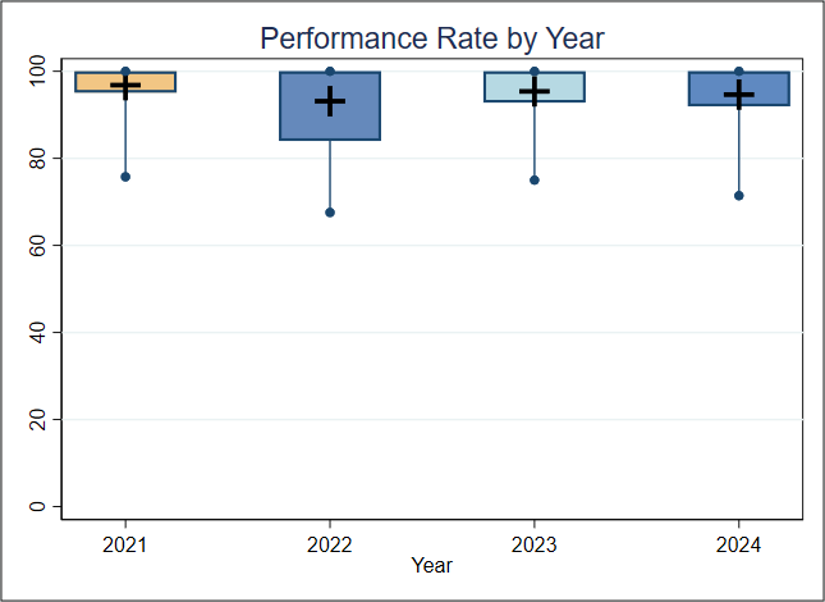
        Figure 1 (Measure Score by PY)
        boxplot

        Figure 1. Boxplot of Performance Rate by Year

        Interpretation (Measure Score by PY)

        Figure 1 Interpretation: For each of the 4 years, at least 20% of clinicians have a 100% performance rate and, except for 2022, at least 80% of the clinicians have a performance rate greater than 90%. For this measure, a higher performance rate indicates better quality of care. 


        About this Analysis (Score Distro)

        About Table 1: Table 1 illustrates the distribution of rates across deciles in the most recent data available. 

        Table 1 (Score Distro)

        Table 1. Importance (Decile by Performance Rate, FY2024)

         MeanDecile 1Decile 2Decile 3Decile 4Decile 5Decile 6Decile 7Decile 8Decile 9Decile 10
        Rate94.771.4-87.187.1-91.992.0-93.393.3-94.794.7-96.796.7-97.197.1-100100100100
        Interpretation (Score Distro)

        Table 1 Interpretation: Nearly all clinicians have a rate greater than 80%, more than 80% of clinicians have a rate greater than 90%, and more than 30% of the clinicians have a performance rate of 100%. If the average performance of Decile 8 (100%) is considered a plausible, achievable rate, and the clinicians in Deciles 1 through 7 improved to reach that rate, the estimated percentage of patients with no return to the operating room within 90 days of surgery would go up by about 5% (from 94.7% to nearly 100%), potentially leading to better health outcomes for these patients.

          Importance Criterion Definition

          The Meaningfulness criterion will be evaluated as part of the full Preliminary Assessment available in September.  

            Criterion Definition

            This criterion will be evaluated as part of the full Preliminary Assessment available in September.  

              Criterion Definition

              This criterion will be evaluated as part of the full Preliminary Assessment available in September.  

              PA Type
              Performance and Impact Analysis (PIA)

              Annual cervical cancer screening or follow-up in high-risk women

              This measure identifies women age 12 to 65 diagnosed with cervical dysplasia (CIN 2), cervical carcinoma-in-situ, or HIV/AIDS prior to the measurement year, and who still have a cervix, who had a cervical CA screen during the measurement year.

              CBE ID
              0579

              Annual monitoring for patients on persistent medications

              The percentage of members 18 years of age and older who received at least 180 treatment days of ambulatory medication therapy for a select therapeutic agent during the measurement year and at least one therapeutic monitoring event for the therapeutic agent in the measurement year. For each product line, report each of the four rates separately and as a total rate.

              • Annual monitoring for members on angiotensin converting enzyme (ACE) inhibitors or angiotensin receptor blockers (ARB)
              • Annual monitoring for members on digoxin
              • Annual monitoring for members on diuretics

              CBE ID
              0021